

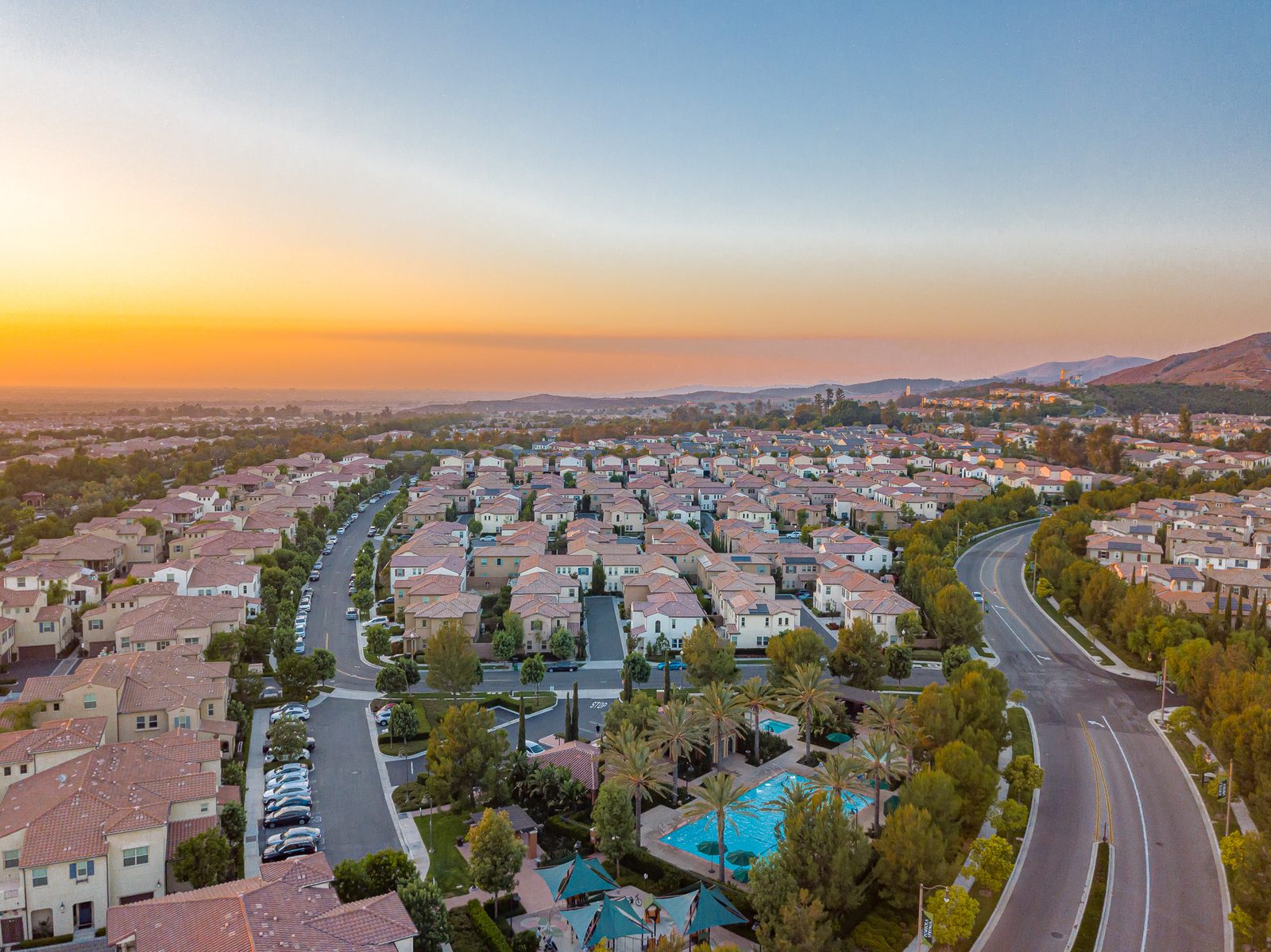
Portola Springs.
Portola Springs is one of Irvine's most sought-after master-planned communities, offering newer homes, scenic mountain views, 19 neighborhood parks, six pools, and access to top-rated Irvine Unified schools, including Portola High School. Whether you're searching for Portola Springs homes for sale, considering a move to Irvine, exploring leasing options, or preparing to sell, this guide has everything you need to know.
Welcome to Portola Springs
Portola Springs is a master-planned community developed by the Irvine Company in the early 2000s, situated in the eastern foothills of Irvine along the Santa Ana Mountains. The community encompasses approximately 4,500 homes across several distinct residential enclaves — each with its own architectural character, price profile, and park access.
What separates Portola Springs from other Irvine villages is its setting. The terrain rises toward the foothills, which means many homes have genuine mountain and city light views — something you simply can't find in flatter parts of the city. Combined with a trail network connecting to the Irvine Open Space Preserve, the community attracts buyers who want modern Irvine living without sacrificing outdoor access.
Housing options span a wide range: attached condominiums and townhomes starting in the low-to-mid $1M range, detached single-family homes across mid-tracts like Arbor and Escala in the $1.5M–$2.2M range, and premium detached homes in the foothills enclaves — Cielo and Sierra — where panoramic views and larger lots push prices above $2.5M. New construction from builders, including Irvine Pacific, continues to add inventory in the highest elevation areas.
The community is built around one 32-acre central park and 18 neighborhood parks, with six pools, tennis and pickleball courts, sports fields, and a community center. The 100-acre Tomato Springs preserve adds a naturalistic buffer at the community's edge that most Irvine neighborhoods don't have.
Quick facts for buyers comparing Irvine & Tustin communities. Verify school assignments and taxes per address.
Get to know more about Portola Springs
~ 12,672
Total Population
36 years
Median Age
$185,000
Average Household Income
3
Average Household Size
~ 4,269
Total Households
Hillside newer homes, parks, trails, and strong family appeal.
Portola Springs Market Snapshot — Q2 2026
Whether you're buying, selling, or leasing, knowing where the market stands is the first step. Here's a current look at Portola Springs real estate.
$1.8M
Median Sale Price
~$776
Price Per Sq Ft
127 days (as of Q1 2026)
Avg Days on Market
8
Homes Sold (Last 30 Days)
+5.5%
Year-Over-Year Price Change
Somewhat competitive — buyer demand steady
Market Condition
The Portola Springs market has shown consistent year-over-year appreciation, with limited new inventory keeping demand competitive. Homes in the foothills sub-tracts — including Arbor, Sierra, and Cielo — tend to command a premium due to mountain views and larger lot sizes. If you're considering a move, now is a good time to understand exactly what your home is worth.
Thinking About Selling Your Portola Springs Home?
Portola Springs sellers have a meaningful advantage right now: inventory remains tight relative to demand, and buyers continue to pay a premium for foothills living, mountain views, and access to Portola High School. But maximizing your sale price in this market requires more than just listing — it requires pricing strategy, presentation, and a deep understanding of which sub-tract your home competes in.
A few things that matter most when selling here:
Sub-tract positioning. Arbor, Sierra, Cielo, and Escala all carry different price profiles. Pricing your home against the wrong comps — even by a few streets — can cost you negotiating leverage.
School proximity. Walkability to Portola Springs Elementary or Jeffrey Trail significantly expands your buyer pool and supports stronger offers.
View premium. Unobstructed mountain or city light views from the foothills sub-tracts command measurable premiums. They need to be photographed and priced correctly.
If you're thinking about selling — even 6 to 12 months out — the conversation starts with understanding your home's current position in the market. We'll give you a clear, honest picture.
Leasing a Home in Portola Springs
Portola Springs is one of Irvine's most sought-after communities for tenants as well as buyers — and for good reason. Access to award-winning IUSD schools (including Portola High), 19 parks, and a quieter foothills setting make it a consistent draw for relocating families, professionals, and those testing the market before purchasing.
Rental Market at a Glance
Typical SFR Rental Range
$4,200 – $7,500/month (varies by size and sub-tract)
Typical Condo/Townhome Range
$3,200 – $4,800/month
Most Common Lease Term
12 months
Common Tenant Profile
Relocating families, IUSD school-focused households
For Tenants
If you're relocating to Irvine and not yet ready to buy, Portola Springs offers some of the best rental inventory in the city. We work with tenants to identify available properties — including off-market and pre-listed units — that match your school district, budget, and timeline.
For Landlords
If you own a home in Portola Springs and are considering leasing it — whether short-term while the market settles or long-term — we handle the full leasing process. This includes tenant screening, lease preparation, and coordination through move-in.
Ask us about current leasing inventory or landlord representation in Portola Springs.
Schools in Portola Springs
Parks in Portola Springs
Getting Around Portola Springs
Portola Springs is a drive-first community by design, with wide streets, light traffic, and convenient access to major freeways. While most errands require a car, daily life within the neighborhood is more walkable than its Walk Score suggests, with schools, parks, pools, and walking trails all located just minutes from many homes. Rather than prioritizing urban walkability, Portola Springs offers a quieter lifestyle with more open space, mountain views, and thoughtfully planned amenities while keeping Irvine's top destinations within a short drive.
Walk to Schools
Many homes are within a 5–10 minute walk of Portola Springs Elementary School and Jeffrey Trail Middle School, making the daily school commute easy for families.
Community Park
The 32-acre Portola Springs Community Park is centrally located and features sports fields, playgrounds, picnic areas, and open green space within walking distance of many neighborhoods.
Parks & Pools
With 19 neighborhood parks and six resort-style pools throughout the village, most residents are only a few minutes from outdoor recreation and community amenities.
Walking Trails
The Silverado Trail and an extensive network of neighborhood paths provide miles of scenic routes for walking, running, and biking while connecting parks and residential areas.
Near John Wayne
John Wayne Airport is typically a 15–20 minute drive, making business trips and weekend getaways convenient.
Near Irvine Spectrum
Irvine Spectrum Center is about 15 minutes away and offers shopping, dining, entertainment, and nightlife.
Freeway Access
Portola Springs is approximately 10–12 minutes from both Interstate 5 (I-5) and the 241 Toll Road, providing convenient access throughout Orange County and beyond.
Quiet Living
While Portola Springs has a lower Walk Score than some Irvine neighborhoods, residents enjoy the benefits of larger homes, mountain views, quieter streets, abundant parks, and a peaceful residential atmosphere.
Fun Facts & Trivia About Portola Springs
Where does the name Portola Springs come from?+
The community is named after Gaspar de Portolà, the Spanish explorer who led the first European land expedition through California in 1769. His team camped near natural springs in the area (originally known as Tomato Springs because of the wild tomatoes growing there). You can still visit a historic plaque marking the exact campsite!
Does Portola Springs have Native American history?+
Yes! The area has over 10,000 years of history belonging to the Acjachemen (Juaneño) people. They called it ‘U∫rónvanga — a busy village and sacred site. Today, the Portola Springs Community Center honors this heritage with the Acjachemen Room and educational displays.
How many parks and pools does Portola Springs have?+
The community features one large 32-acre Community Park plus 18 neighborhood parks, 6 pools (including a Jr. Olympic-size pool), tennis and pickleball courts, sports fields, BBQ areas, and miles of scenic trails.
Has Portola Springs won any community awards?+
Yes — it has been recognized as “Village of the Year” for its incredible community design, high-tech schools, and resort-style amenities that bring residents together.
Portola Springs Sub-Tracts at a Glance
San Carlos (2006–2008)
Attached townhomes and flats by William Lyon Homes. 1–3 bed, 1,040–1,671 sq ft. Entry-level price point; one of the first Portola Springs tracts to deliver.
San Carlos Court (2006–2008)
Attached townhomes and flats by William Lyon Homes. Slightly larger than San Carlos — 1,126–1,901 sq ft, 1–3 bed. Shares community courts and pool access.
Los Arboles (2008–2010)
Detached SFRs by Taylor Morrison. 2,003–2,382 sq ft, 3–4 bed. Santa Barbara/Monterey architecture. Among the early mid-size detached offerings in the village.
Manzanita (2008–2010)
Attached alley-loaded townhomes. Compact footprint, well-suited for smaller households. Good access to community trails and parks.
Sage (2008–2010)
Detached SFRs. Mid-size 3–4 bed homes with Spanish-influenced architecture. Established resale market with strong school proximity.
Casero (2009–2011)
Attached condos and townhomes. 2–3 bed, mid-size layouts. One of the more affordable entry points into the Portola Springs resale market.
Sendero (2009–2011)
Attached townhomes with 3-story layouts in some plans. Good value per square foot relative to newer tracts.
Montara (2010–2012)
Detached SFRs by Standard Pacific (now CalAtlantic/Lennar). 3–4 bed, open floor plans. Strong mid-village location with park access.
Cressa (2010–2012)
Detached SFRs. 3–4 bed layouts, two-story designs. Sought after for lot size and quiet cul-de-sac streets.
Juniper (2010–2012)
Detached SFRs. 3–4 bed, approx. 2,000–2,500 sq ft. Traditional Spanish architecture; well-established resale community.
Ironwood (2010–2012)
Detached SFRs by Irvine Pacific. 3 bed, 1,882–2,137 sq ft. Hillside-adjacent positioning; some views available on premium lots.
Indigo (2010–2012)
Attached and detached options. Mid-size layouts popular with smaller families and downsizers.
Elderberry (2010–2013)
Detached SFRs. 3–4 bed, open-concept layouts. Good school walkability; strong demand in resale.
Citrine (2011–2013)
Detached SFRs. 3–4 bed with California Room options. Consistent resale performer; traditional PS architecture.
Colibri (2011–2013)
Attached condos and townhomes. 2–3 bed, good sq ft value. Strong rental demand in this size range.
Paloma (2011–2013)
Detached SFRs. 3–4 bed, two-story open-concept plans. Positioned near greenbelts and neighborhood parks.
Celeste (2012–2014)
Detached SFRs. 3–4 bed, 2,000–2,600 sq ft. Slightly elevated positioning with mountain views on select lots.
Prado (2012–2014)
Attached townhomes and condos. 2–3 bed, modern layouts. Affordable entry into PS; popular with first-time buyers.
Brisa (2012–2014)
Attached townhomes. 2–3 bed tri-level plans common. Compact and efficient; near community pool access.
Carissa (2012–2015)
Detached SFRs. 3–4 bed, larger lot options. Newer construction with updated standard finishes vs earlier phases.
Quinterra (2013–2015)
Attached and detached. Mix of 2–4 bed. Good mid-community location with park proximity.
Las Colinas (2013–2015)
Detached SFRs. 3–5 bed, larger footprints. Popular with growing families needing 4+ bed detached product.
Las Ventanas (2013–2015)
Detached SFRs. 3–4 bed. Higher elevation within the village; some panoramic views on select lots.
Legado (2013–2016)
Detached SFRs. 4–5 bed, premium sq ft range. Positioned in the upper-middle tier of PS pricing.
Vientos (2013–2016)
Attached townhomes. 3–4 bed, modern open plans. Strong commuter demand given freeway access.
Silverleaf (2014–2016)
Detached SFRs. 3–4 bed, upgraded standard inclusions vs earlier phases. Well-located relative to Portola Springs Elementary.
Talise (2014–2016)
Attached condos. 2–3 bed, modern finishes. Entry-level price point with resort amenity access.
The Vine (2014–2016)
Detached SFRs. 3–4 bed, California Room standard on most plans. Popular for outdoor living features.
Willow (2014–2016)
Detached SFRs. 3–4 bed. Greenbelt-adjacent lots available; consistent resale demand.
Highland (2016–2018)
Detached SFRs by Irvine Pacific. 3–4 bed, 2,000–2,500 sq ft. Elevated position in the community with foothills views on select lots.
Garden Hill (2016–2018)
Detached SFRs. 3–4 bed. Mid-elevation positioning between core village and upper hillside tracts.
Luna (2016–2019)
Detached SFRs. 3–4 bed, larger floor plans. Quiet streets with greenbelt and open space adjacency.
Decada (2017–2019)
Attached townhomes and condos. 2–3 bed modern plans. Newer construction with updated finishes and energy efficiency.
Cariz (2017–2019)
Attached stacked flats and 3-story townhomes by Tri Pointe Homes. 1,235–2,101 sq ft, 2–4 bed. Good value-per-sq-ft in newer construction.
Hillside (2018–2020)
Detached SFRs by Irvine Pacific. 3 bed, 1,882–2,137 sq ft. Scenic hillside positioning; lower sq ft but strong views. Popular with smaller households.
Bluffs (2020–2022)
Detached SFRs by Irvine Pacific. 3–4 bed, premium lots on the bluff line. Views of city lights and mountains on select lots; among the last IP-built tracts before the Shea/CalPac phase.
Fiore (2022–2024)
Detached SFRs by California Pacific Homes. 2,035–2,410 sq ft, 3–4 bed. Modern open plans with California Room standard. Mid-range price point for new construction.
Sierra (2022–2024)
Detached SFRs by California Pacific Homes. 2,220–2,704 sq ft, 3–4 bed. Upper village positioning with foothills views. Premium finishes standard. $1.9M–$2.5M range.
Azul (2022–2024)
Detached SFRs by California Pacific Homes. 2,787–3,552 sq ft, 4–5 bed. Largest CalPac offering in PS. Elevated site with city light views; one of the higher price points in current inventory. $2.2M–$3.0M range.
Olivewood (2022–2024)
Detached SFRs by Risewell Homes (formerly The New Home Company). 2,870–3,220 sq ft, 4–5 bed. Hillside-elevated with panoramic views; premium lot premiums for view-line positions. $2.5M–$3.5M+ range.
Arbor (2023–present)
Detached SFRs by Shea Homes. 2,133–2,420 sq ft, 3–4 bed. Spanish/Monterey architecture. Shared auto court layout. Strong school proximity. From ~$1.6M.
Cielo (2023–present)
Detached SFRs by Shea Homes. 3,225–3,473 sq ft, 4–5 bed. Highest-elevation new construction in Portola Springs. Panoramic city and mountain views. Optional guest suite. Newest and largest Shea offering in the village. From ~$2.7M.
Where is Portola Springs?
Portola Springs sits in the North Irvine area. Compare it with neighboring communities, or open the map to explore streets, parks, and commute routes.
Local resources: City of Irvine, Irvine Unified schools
More on Portola Springs
- The Portola Springs Amenity Map Nobody Hands You at Closing →
- Irvine Just Opened a 1,200-Foot Bridge Over the 5. Here's Which Villages Got More Valuable. →
- From Asphalt Plant to 1,100+ Homes: Inside Irvine's New Gateway Village →
- Irvine Was Just Named America's Safest Big City Again — Here's What That Means for Your Home →
- Which Irvine Schools Come With Your House? A Village-by-Village Guide for Buyers →
No one knows our cities as well as we do.
Street-level comps, school boundaries, HOA and Mello-Roos context — we live these markets daily. Let's talk about your move.